

A Japanese Icon, Woven in Nishijin-ori
Master Artisans of Weaving
Prologue
What material is worthy of the finest seat?
In the 1960s, fine leather was the conventional choice in Europe and the United States.
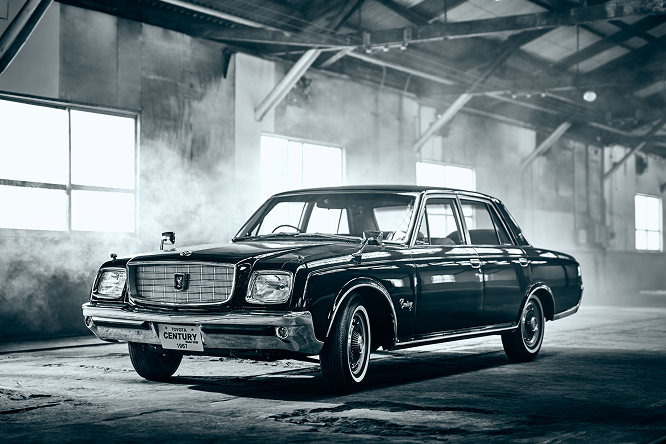
Yet the first-generation Century chose a different answer: Nishijin-ori, a traditional Japanese textile.
Behind that choice was the vision of Chief Engineer Kenya Nakamura and Shoichiro Toyoda to create a car rooted in Japanese tradition that Japan could proudly present to the world.
That vision resonated with the master artisans, who brought their passion to the challenge of developing Nishijin-ori seats.
From the birth of the first-generation Century to the latest Coupe,
Nishijin-ori seats have carried tradition forward while continuing to evolve.
Woven into them is the pride of the master artisans.
Chapter 1 Taking Art Textiles Down an Uncharted Road
At the time, most seat upholstery was still made of polyvinyl chloride (PVC).
What kind of seat would be worthy of a luxury car like the first-generation Century?
It was a challenge of trial and error.
The only reference was the Nishijin-ori seat the master artisans had pioneered for a passenger car. To achieve the finest texture and durability, they continued to refine their techniques even further.
What set the seat apart was its yarn and the way it was woven.
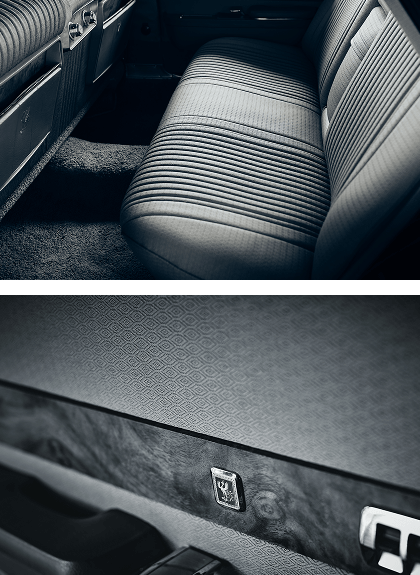
A textured nylon yarn was chosen, softer than conventional filament yarn.
The yarns were woven using a combination of smooth donsu weaving and fukuro weaving, a double-layered technique that gives the fabric a soft fullness.
Particularly striking was the choice of a low-speed loom to preserve the yarn’s wool-like feel, taking around ten times longer to complete the weaving.
The simple hexagonal pattern is based on the traditional Shokkōkin motif. Each hexagon evokes elegance and dignity that are distinctly Made in Japan.
The result, woven in collaboration with a world-renowned Nishijin-ori manufacturer, was a seat Japan could proudly present to the world.
It also marked a historic step as Japanese art textiles moved beyond conventional boundaries and into the world of industrial products.

Chapter 2 100 Prototypes Lead to the Beauty of Restraint
The Nishijin-ori techniques developed for the first-generation Century were later carried forward into a dedicated vehicle for a figure who symbolizes Japan, lending it an even greater sense of distinction and dignity.
In 2025, that DNA was carried forward into the development of the seats for the Century Coupe concept car.
The Coupe called for a fabric that would beautifully envelop the entire interior, from the seats to the doors and beyond.
However, in an interior defined by horizontal and vertical lines, a pattern like that of the first-generation Century would stand out too much.
“How could the pattern be made more restrained and brought into harmony with the entire interior?”
After more than 100 prototypes, the master artisans arrived at one answer.
It was a fabric with no pattern, simple yet rich in depth.
This understated design is the very embodiment of Century’s “beauty of restraint.”
“When we saw the fabric installed in the car, we knew it was the right answer.”
For the master artisans, who had tended to focus on the textile itself, this marked an evolution in perspective: from the textile alone to its harmony with the entire interior.
Chapter 3 Scarlet Pride Woven into Black
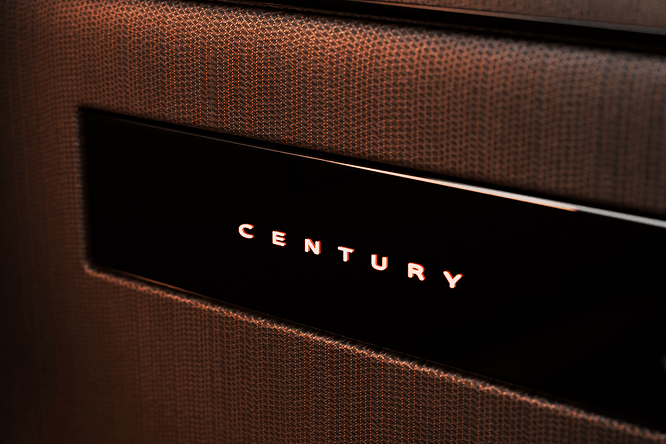
Black that shifts beautifully from one angle to another.
From within, a subtle hint of scarlet emerges.
At first glance, the Coupe seat fabric appears unpatterned, yet its expression is anything but plain.
The first secret behind these subtle changes lies in the yarns used for both the warp and weft.
Could weaving together multiple yarns create deep shading and subtle variations within an unpatterned fabric?
Through repeated trial and error, the master artisans arrived at a combination of six yarns.
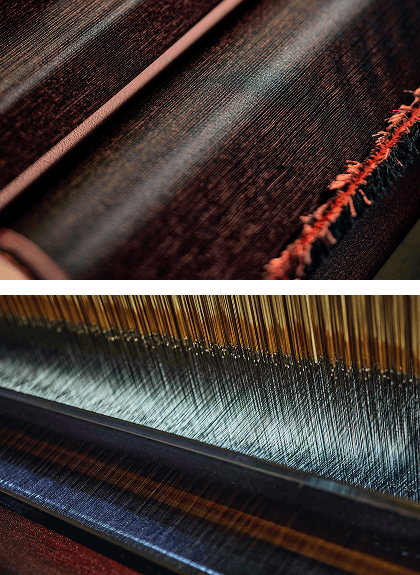
The warp pairs black with gray, while the weft combines scarlet with two black yarns of different thicknesses and a black-and-scarlet blend.
There was another secret, hidden in the structure of the weave.
Based on the donsu weaving inherited from the first-generation Century, the fabric was woven at high density. The scarlet yarn was woven to reveal itself subtly from within, creating a remarkable sense of depth as the angle of light changes.
Layering traditional techniques to invent new beauty.
Woven into the scarlet glow hidden within the black is the passion of the master artisans.

Chapter 4 Quality Is Shaped by Character Japanese Beauty, Unbound
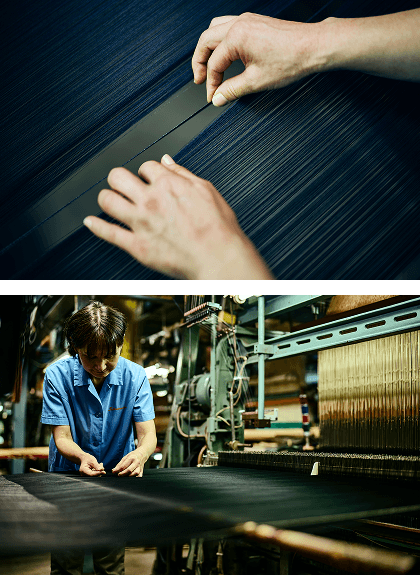
If a flaw is found, the threads are unraveled to that point and rewoven.
Behind the seat’s comfort is an uncompromising dedication.
At its core is the enduring teaching that “quality is shaped by character.”
This is the spirit of the master artisans, carried from the first-generation Century to the Coupe.
To pass that character and skill on to the next generation, the master artisans are now bringing the craft in-house.
The aim is both to protect the livelihoods of younger artisans and to teach them how highly their handwork is valued.
To take deep pride in one’s work.
That pride helps cultivate an artisan’s character.
With pride and refined skill, the master artisans bring the Japanese aesthetic of harmony to the world stage.
They breathe new life into the old, at times going beyond tradition to forge a path to the future.
Their challenge continues.
With the cooperation of:
Tatsumura Textile Co., Ltd. / AUNDE Boshoku Co., Ltd.
With the cooperation of:
Tatsumura Textile Co., Ltd. / AUNDE Boshoku Co., Ltd.
